
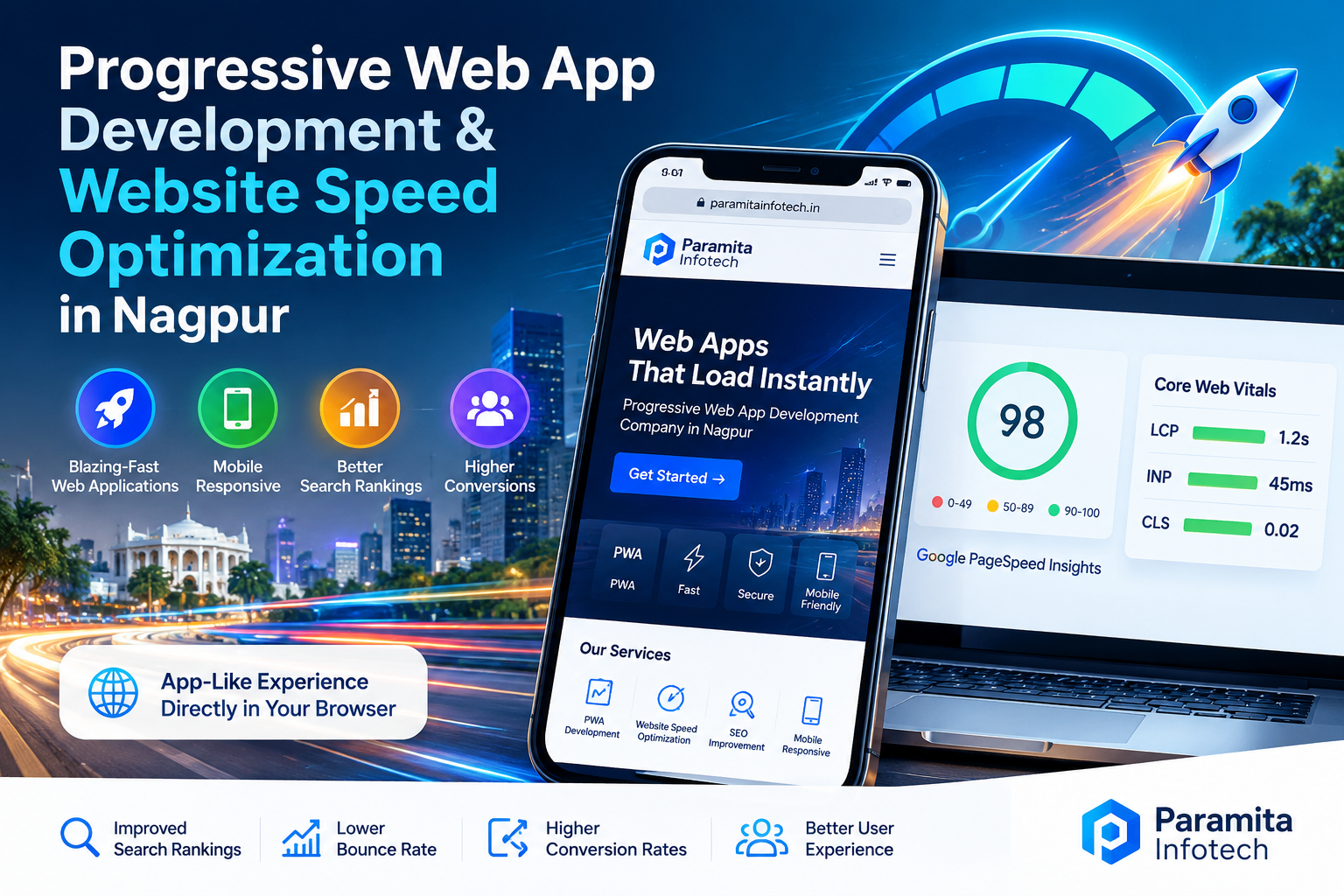
Slow-loading websites and poor mobile responsiveness can frustrate visitors, increase abandonment and reduce conversions. For businesses looking to strengthen their online presence, website performance is an important part of delivering a better user experience.
Paramita Infotech, a software development company serving businesses in Nagpur, provides Progressive Web App (PWA) development and website speed optimization services designed to improve website performance across devices.
Our approach includes Core Web Vitals analysis, render-blocking resource optimization, image compression, browser caching and responsive design improvements. Progressive Web Apps can also deliver an app-like browsing experience directly through a web browser, with installability and offline capabilities where supported and implemented.
Whether you want to improve an existing website or develop a modern web application, Paramita Infotech can help you explore the right technical approach for your business requirements.
Visit paramitainfotech.in to learn more about our web development services.
In today’s digital world, website speed and mobile responsiveness play a crucial role in business success. A slow-loading website can frustrate visitors, increase bounce rates and reduce conversions. For businesses looking to strengthen their online presence, investing in Progressive Web App development and website speed optimization services in Nagpur can help deliver a faster, smoother and more engaging user experience.
Paramita Infotech helps businesses build modern, high-performance web applications and optimize existing websites for speed, usability and mobile compatibility. From Core Web Vitals optimization to Progressive Web App development, our solutions focus on making digital experiences more accessible, responsive and efficient.
If you want to improve your website’s performance and provide your customers with an app-like browsing experience, the right web development strategy can make a measurable difference.
Why Website Speed Matters for Your Business
Website speed directly influences how visitors interact with your business online. Users expect pages to load quickly, navigation to work smoothly and content to display correctly across different devices.
When a website takes too long to load, visitors may leave before exploring your products or services. This can affect lead generation, customer engagement and sales opportunities.
A properly optimized website can help businesses:
- Deliver a better user experience.
- Reduce delays during page navigation.
- Improve mobile usability.
- Support better conversion rates.
- Improve performance on search engine evaluation metrics.
- Make important information accessible more quickly.
Website speed is also relevant to search engine optimization. Google uses page experience signals, including Core Web Vitals, as part of its broader ranking systems. However, optimizing website speed alone does not guarantee higher rankings because search visibility depends on multiple factors, including content relevance, competition and technical SEO.
What Is Progressive Web App (PWA) Development?
A Progressive Web App (PWA) is a web application that uses modern web technologies to provide an experience similar to a native mobile application.
Unlike traditional mobile applications, a PWA can be accessed through a web browser without requiring users to download it from an app store. Depending on its implementation and the user’s device, it may also support installation, offline access and push notifications.
Progressive Web Apps combine the accessibility of websites with selected features commonly associated with mobile applications.
Key Features of Progressive Web Apps
1. Fast Loading Performance
Progressive Web Apps can use caching strategies and service workers to improve loading performance and support access to selected content when connectivity is limited.
2. Mobile-Friendly Experience
A responsive PWA adapts its interface to different screen sizes, helping users navigate comfortably on smartphones, tablets and desktops.
3. Installable Web Experience
Where supported, users can install a PWA on their devices and access it from an app-like icon without going through a traditional app store installation process.
4. Offline Capabilities
Developers can configure service workers and caching to make specific pages or features available offline. The extent of offline functionality depends on the application’s design.
5. Easier Accessibility
Users can access the application through a web link, making it easier for businesses to share their services, products and digital tools.
At Paramita Infotech, we focus on building web applications that align with business requirements, performance goals and the needs of their target audience.
Website Speed Optimization Services in Nagpur
If your website is slow, improving its performance requires more than simply reducing image sizes. A technical audit can identify the issues affecting page loading, responsiveness and visual stability.
Paramita Infotech can help businesses identify and address website performance bottlenecks through a structured optimization process.
1. Core Web Vitals Optimization
Core Web Vitals are Google’s metrics for evaluating important aspects of user experience.
The three primary metrics are:
- Largest Contentful Paint (LCP): Measures how quickly the main content becomes visible.
- Interaction to Next Paint (INP): Measures how quickly a page responds to user interactions.
- Cumulative Layout Shift (CLS): Measures unexpected visual movement during page loading.
Google’s recommended thresholds, assessed at the 75th percentile of page visits, are:
| Metric | Good Performance |
|---|---|
| LCP | 2.5 seconds or less |
| INP | 200 milliseconds or less |
| CLS | 0.1 or less |
Monitoring these metrics helps developers identify performance problems and prioritize improvements that benefit real users.
2. Image Compression and Optimization
Large image files can increase page loading time, particularly for users accessing websites through mobile networks.
Image optimization can include:
- Compressing images while maintaining acceptable visual quality.
- Using modern formats such as WebP or AVIF where appropriate.
- Serving responsive image sizes for different devices.
- Implementing lazy loading for below-the-fold images.
- Specifying image dimensions to reduce layout shifts.
These techniques can reduce unnecessary data transfer and improve the overall browsing experience.
3. JavaScript and CSS Optimization
Unnecessary scripts, large stylesheets and render-blocking resources can delay the display of important page content.
Website performance optimization may involve:
- Removing unused CSS and JavaScript.
- Minifying code files.
- Deferring non-critical JavaScript.
- Loading essential resources efficiently.
- Reducing unnecessary third-party scripts.
- Splitting large application bundles where appropriate.
The correct approach depends on the website’s technology stack and how its pages are rendered.
4. Browser Caching and Content Delivery
Browser caching allows supported resources to be reused during subsequent visits instead of being downloaded again unnecessarily.
Depending on the website architecture, performance improvements may include:
- Configuring appropriate cache-control headers.
- Using content delivery networks (CDNs).
- Optimizing server response times.
- Compressing text-based resources.
- Reducing unnecessary network requests.
For businesses serving customers across different locations, these improvements can help deliver a more consistent browsing experience.
5. Mobile Responsiveness Optimization
A mobile-friendly website should remain readable, functional and easy to navigate on different screen sizes.
Our optimization approach can include reviewing:
- Responsive layouts and flexible grids.
- Font sizes and text readability.
- Mobile navigation and menu functionality.
- Button sizes and touch interactions.
- Image scaling and content spacing.
- Mobile-specific loading and rendering issues.
A responsive website helps visitors access important business information without struggling with horizontal scrolling, overlapping elements or difficult navigation.
Benefits of Progressive Web Apps for Businesses
Progressive Web App development can be useful for businesses that want to improve accessibility and deliver app-like functionality through the web.
Improved User Experience
Fast navigation, responsive interfaces and thoughtfully designed interactions help customers access information with less friction.
Better Accessibility Across Devices
A single web application can serve users across supported browsers and devices, reducing the need to maintain completely separate interfaces for every platform.
Potentially Higher Engagement
Features such as installability, selected offline functionality and push notifications, when supported and appropriately implemented, can help businesses maintain engagement with their audiences.
Reduced Installation Friction
Customers can open a web link directly instead of being required to download a traditional mobile application before exploring the service.
Support for Business Growth
A well-designed web application can support lead generation, customer self-service, product discovery and other digital business objectives.
Actual results depend on the application’s features, implementation quality, audience needs and business model.
How Website Speed Optimization Can Support SEO
Search engine optimization involves several interconnected activities, including content quality, technical accessibility, internal linking, mobile usability and website performance.
Website speed optimization supports this process by helping search engines and visitors access pages efficiently.
Here are some important areas to consider:
Technical SEO: Ensure that important pages can be crawled and indexed correctly.
Core Web Vitals: Measure real-world loading performance, interactivity and visual stability.
Mobile Usability: Make content and navigation accessible on smaller screens.
Image SEO: Use descriptive filenames, meaningful alternative text and appropriately sized images.
Internal Linking: Connect relevant blog posts with service pages to help visitors discover related information.
Content Quality: Answer users’ questions with accurate, useful and original information.
No technical optimization can guarantee a particular search position. However, a combination of relevant content, sound technical implementation and a good user experience provides a stronger foundation for sustainable SEO.
Why Choose Paramita Infotech for Web Development in Nagpur?
Choosing the right development partner is important when building a high-performance website or improving an existing digital platform.
Paramita Infotech provides software and web development services for businesses seeking practical, technology-driven solutions.
Our approach focuses on:
- Custom Web Development: Web applications designed around specific business requirements.
- Progressive Web App Development: Browser-based applications with suitable app-like features.
- Website Speed Optimization: Technical improvements based on performance audits.
- Responsive Website Development: Interfaces designed for mobile, tablet and desktop devices.
- Technical SEO Support: Improvements to website structure, metadata and technical accessibility.
- Performance Testing: Evaluating loading speed, responsiveness and layout stability using appropriate tools.
Whether you operate a startup, small business or established enterprise, our team can help you identify suitable improvements based on your website’s current performance and business goals.
Visit our website at https://paramitainfotech.in/ to explore our services.
Frequently Asked Questions (FAQs)
1. What is Progressive Web App development?
Progressive Web App development involves building web applications that use modern browser technologies to provide features such as responsive interfaces, installability and selected offline capabilities where supported.
2. Why is website speed optimization important?
Website speed optimization helps reduce unnecessary loading delays, improves usability and supports a smoother customer journey. It can also help websites meet Google’s Core Web Vitals performance thresholds.
3. How can I improve my website loading speed?
Start by testing your website with Google PageSpeed Insights. Review Core Web Vitals, optimize images, reduce unnecessary JavaScript and CSS, configure browser caching and investigate slow server responses.
4. Does website speed affect Google rankings?
Website speed and page experience signals can contribute to Google’s ranking systems. However, rankings also depend on content relevance, quality, competition, technical accessibility and many other factors.
5. Can a Progressive Web App work without an internet connection?
A PWA can support offline access when developers implement suitable service workers and caching strategies. Offline availability varies according to the features and content configured for the application.
6. How can I get website speed optimization services in Nagpur?
You can contact Paramita Infotech through https://paramitainfotech.in/ to discuss your website requirements, performance concerns and potential optimization strategies.
Conclusion
A fast, responsive website is an important part of delivering a reliable digital experience. Slow loading, unresponsive interfaces and unnecessary technical overhead can create barriers between your business and potential customers.
Progressive Web App development offers another way to deliver accessible, app-like web experiences, while website speed optimization helps address performance issues that affect real users.
Paramita Infotech provides web development and website performance optimization solutions for businesses in Nagpur. By combining responsive design, technical optimization and modern web technologies, businesses can build a stronger foundation for customer engagement and digital growth.
Looking to improve your website performance or develop a Progressive Web App?
Visit https://paramitainfotech.in/ to discuss your web development requirements with Paramita Infotech.
