
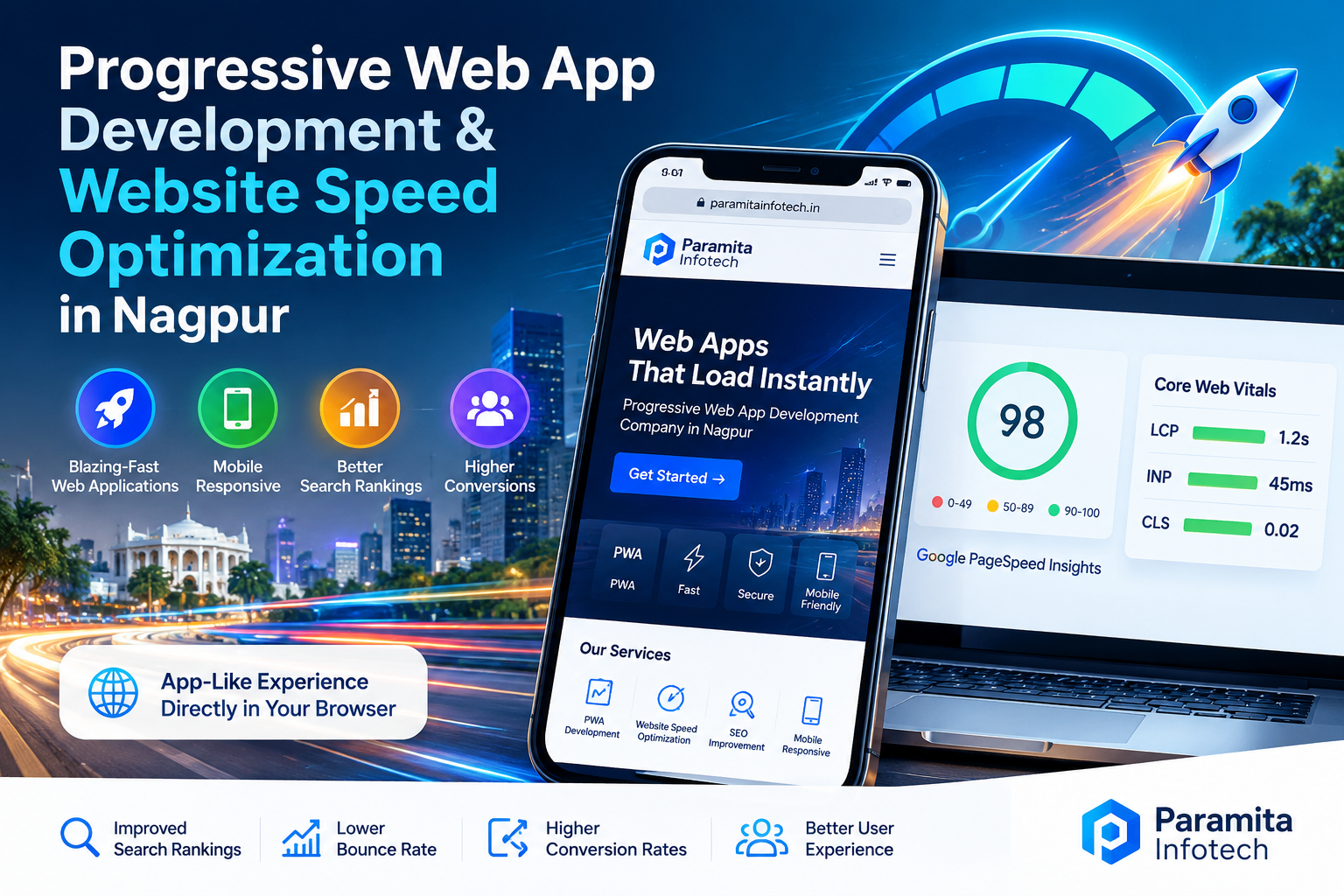
Slow-loading websites and poor mobile responsiveness can frustrate visitors, increase abandonment and reduce conversions. For businesses looking to strengthen their online presence, website performance is an important part of delivering a better user experience. Paramita Infotech, a software development company serving businesses in Nagpur, provides Progressive Web App (PWA) development and website speed optimization services designed to improve website performance across devices. Our approach includes Core Web Vitals analysis, render-blocking resource optimization, image compression, browser caching and responsive design improvements. Progressive Web Apps can also deliver an app-like browsing experience directly through a web browser, with installability and offline capabilities where supported and implemented. Whether you want to improve an existing website or develop a modern web application, Paramita Infotech can help you explore the right technical approach for your business requirements. Visit paramitainfotech.in to learn more about our web development services. In today’s digital world, website speed and mobile responsiveness play a crucial role in business success. A slow-loading website can frustrate visitors, increase bounce rates and reduce conversions. For businesses looking to strengthen their online presence, investing in Progressive Web App development and website speed optimization services in Nagpur can help deliver a faster, smoother and more engaging user experience. Paramita Infotech helps businesses build modern, high-performance web applications and optimize existing websites for speed, usability and mobile compatibility. From Core Web Vitals optimization to Progressive Web App development, our solutions focus on making digital experiences more accessible, responsive and efficient. If you want to improve your website’s performance and provide your customers with an app-like browsing experience, the right web development strategy can make a measurable difference. Why Website Speed Matters for Your Business Website speed directly influences how visitors interact with your business online. Users expect pages to load quickly, navigation to work smoothly and content to display correctly across different devices. When a website takes too long to load, visitors may leave before exploring your products or services. This can affect lead generation, customer engagement and sales opportunities. A properly optimized website can help businesses: Website speed is also relevant to search engine optimization. Google uses page experience signals, including Core Web Vitals, as part of its broader ranking systems. However, optimizing website speed alone does not guarantee higher rankings because search visibility depends on multiple factors, including content relevance, competition and technical SEO. What Is Progressive Web App (PWA) Development? A Progressive Web App (PWA) is a web application that uses modern web technologies to provide an experience similar to a native mobile application. Unlike traditional mobile applications, a PWA can be accessed through a web browser without requiring users to download it from an app store. Depending on its implementation and the user’s device, it may also support installation, offline access and push notifications. Progressive Web Apps combine the accessibility of websites with selected features commonly associated with mobile applications. Key Features of Progressive Web Apps 1. Fast Loading Performance Progressive Web Apps can use caching strategies and service workers to improve loading performance and support access to selected content when connectivity is limited. 2. Mobile-Friendly Experience A responsive PWA adapts its interface to different screen sizes, helping users navigate comfortably on smartphones, tablets and desktops. 3. Installable Web Experience Where supported, users can install a PWA on their devices and access it from an app-like icon without going through a traditional app store installation process. 4. Offline Capabilities Developers can configure service workers and caching to make specific pages or features available offline. The extent of offline functionality depends on the application’s design. 5. Easier Accessibility Users can access the application through a web link, making it easier for businesses to share their services, products and digital tools. At Paramita Infotech, we focus on building web applications that align with business requirements, performance goals and the needs of their target audience. Website Speed Optimization Services in Nagpur If your website is slow, improving its performance requires more than simply reducing image sizes. A technical audit can identify the issues affecting page loading, responsiveness and visual stability. Paramita Infotech can help businesses identify and address website performance bottlenecks through a structured optimization process. 1. Core Web Vitals Optimization Core Web Vitals are Google’s metrics for evaluating important aspects of user experience. The three primary metrics are: Google’s recommended thresholds, assessed at the 75th percentile of page visits, are: Metric Good Performance LCP 2.5 seconds or less INP 200 milliseconds or less CLS 0.1 or less Monitoring these metrics helps developers identify performance problems and prioritize improvements that benefit real users. 2. Image Compression and Optimization Large image files can increase page loading time, particularly for users accessing websites through mobile networks. Image optimization can include: These techniques can reduce unnecessary data transfer and improve the overall browsing experience. 3. JavaScript and CSS Optimization Unnecessary scripts, large stylesheets and render-blocking resources can delay the display of important page content. Website performance optimization may involve: The correct approach depends on the website’s technology stack and how its pages are rendered. 4. Browser Caching and Content Delivery Browser caching allows supported resources to be reused during subsequent visits instead of being downloaded again unnecessarily. Depending on the website architecture, performance improvements may include: For businesses serving customers across different locations, these improvements can help deliver a more consistent browsing experience. 5. Mobile Responsiveness Optimization A mobile-friendly website should remain readable, functional and easy to navigate on different screen sizes. Our optimization approach can include reviewing: A responsive website helps visitors access important business information without struggling with horizontal scrolling, overlapping elements or difficult navigation. Benefits of Progressive Web Apps for Businesses Progressive Web App development can be useful for businesses that want to improve accessibility and deliver app-like functionality through the web. Improved User Experience Fast navigation, responsive interfaces and thoughtfully designed interactions help customers access information with less friction. Better Accessibility Across Devices A single web application can serve users across supported browsers and devices, reducing the need to maintain completely separate interfaces

Energy-Efficient Data Centers: The Next Big Trend – 1
Energy-Efficient Data Centers: The Next Big Trend Introduction In today’s hyper-connected world, data centers form the backbone of digital transformation. They power everything from cloud computing to artificial intelligence (AI) and big data analytics. However, this rapid growth comes with significant energy demands, leading to heightened concerns about sustainability and environmental impact. Enter energy-efficient data centers, the next big trend reshaping the IT landscape. With advancements in green technology, cooling systems, and renewable energy integration, businesses are prioritizing eco-friendly practices to reduce their carbon footprint. The Growing Importance of Energy Efficiency The global push for sustainability has never been stronger. Governments, businesses, and consumers are increasingly aware of the environmental challenges posed by traditional data centers. According to recent studies, data centers account for about 1% of global electricity consumption, a figure expected to grow as digitalization accelerates. This creates an urgent need to adopt energy-efficient practices that align with global sustainability goals. Key Statistics Data centers consume approximately 200 terawatt-hours of electricity annually. By 2030, global data storage demands are expected to increase by 30-40%. Transitioning to energy-efficient data centers can reduce electricity consumption by up to 40%. What Makes a Data Center Energy-Efficient? Energy-efficient data centers are designed to optimize power usage while maintaining high performance. They incorporate various technologies and strategies to minimize energy waste and maximize efficiency. Here are the primary components: Efficient Cooling Systems Traditional data centers rely heavily on air conditioning systems that consume vast amounts of energy. Modern energy-efficient data centers utilize advanced cooling techniques such as: Liquid cooling: Transfers heat more efficiently than air-based systems. Free cooling: Utilizes outdoor air or water to reduce reliance on mechanical cooling. Hot and cold aisle containment: Separates hot and cold air to prevent mixing and improve efficiency. Renewable Energy Integration Leveraging renewable energy sources like solar, wind, and hydroelectric power can significantly reduce a data center’s carbon footprint. Companies like Google and Microsoft have pledged to run their data centers entirely on renewable energy in the coming years. Energy-Efficient Hardware Modern servers, storage systems, and networking equipment are designed to consume less power while delivering higher performance. Technologies like solid-state drives (SSDs) and low-power processors play a crucial role. Power Usage Effectiveness (PUE) PUE is a key metric for measuring data center energy efficiency. A PUE of 1.0 indicates optimal efficiency, where all energy is used solely for IT equipment. Energy-efficient data centers strive for a PUE as close to 1.0 as possible. Benefits of Energy-Efficient Data Centers Cost Savings Energy-efficient technologies reduce operational costs by lowering electricity bills. Companies can reinvest these savings into innovation and growth. Environmental Impact Reducing energy consumption translates to fewer greenhouse gas emissions, aligning businesses with global sustainability goals. Enhanced Reliability Efficient cooling and power systems improve the reliability and uptime of data centers, ensuring seamless operations. Regulatory Compliance Governments worldwide are introducing stricter regulations on energy usage. Energy-efficient data centers help businesses comply with these standards and avoid penalties. Trends Driving Energy Efficiency in Data Centers AI and Automation Artificial intelligence (AI) is transforming data center operations by optimizing energy usage. AI-driven systems can predict cooling needs, manage workloads, and balance power distribution in real time. Edge Computing As edge computing gains traction, smaller, decentralized data centers are becoming more common. These facilities are designed to be energy-efficient by default, leveraging local power sources and reducing transmission losses. Hyperscale Data Centers Hyperscale facilities, operated by tech giants like Amazon Web Services (AWS) and Microsoft Azure, are setting new benchmarks in energy efficiency. They employ innovative designs and renewable energy to power massive operations sustainably. Liquid Cooling Technologies Liquid cooling is emerging as a game-changer for energy efficiency. By using liquids to absorb and transfer heat, this technology significantly reduces the energy required for cooling compared to traditional air systems. Challenges in Adopting Energy-Efficient Practices High Initial Investment Transitioning to energy-efficient infrastructure requires significant upfront costs. However, the long-term savings often justify the investment. Technical Expertise Implementing advanced technologies like AI-driven energy management and renewable integration requires specialized skills. Scalability Issues Scaling energy-efficient practices across multiple facilities can be complex and resource-intensive. Regulatory Hurdles Navigating the diverse regulatory landscapes across regions can be challenging for global enterprises. Case Studies: Leaders in Energy Efficiency Google Google’s data centers are among the most energy-efficient globally, boasting an average PUE of 1.12. The company leverages AI to optimize energy usage and runs entirely on renewable energy. Microsoft Microsoft has committed to becoming carbon-negative by 2030. Its data centers use advanced cooling systems and renewable energy to achieve this goal. Facebook Facebook’s data centers prioritize efficiency with designs that incorporate free cooling and renewable energy. The company’s PUE averages 1.10 across its facilities. The Future of Energy-Efficient Data Centers The future of energy-efficient data centers is bright, driven by technological advancements and increasing demand for sustainable practices. Key trends to watch include: The adoption of AI-driven energy management systems. Greater reliance on renewable energy sources. The emergence of modular and portable data centers. Advances in quantum computing, which promise unprecedented efficiency. Conclusion Energy-efficient data centers are not just a trend but a necessity for the sustainable future of technology. By adopting innovative practices and embracing green technologies, businesses can reduce costs, enhance reliability, and contribute to global sustainability goals. As the demand for data continues to rise, energy efficiency will remain a critical focus for the IT industry.

Impact of IT Trends on Business Landscape
Discover the significance of IT trends like cloud computing, artificial intelligence, and machine learning. Learn how these technologies are reshaping the business landscape and driving innovation.

Introduction to Blockchain Technology Overview
Discover the transformative impact of blockchain technology on digital data management. Explore how its decentralized, transparent, and immutable features enhance security and trust across industri…

Navigating Cybersecurity Threats in Cybersecurity 2024
Explore the evolving cybersecurity 2024, highlighting the most common threats and the innovative tactics used by cybercriminals. Stay informed on how to protect yourself in this rapidly changing environment.

